
The use of one’s personal vehicle for business trips entitles the employee, subject to conditions, to reimbursement of mileage expenses by the employer, in the form of a flat rate or actual mileage allowance. The calculation of mileage expenses and allowances follows strict standards. Here are the rules and tips to make it easier for employees and the accounting department.
Reimbursement of mileage expenses by the employer
Mileage charge: what is it?
Business expenses refer, for reference, to the expenses incurred by employees in the course of their professional activity and in the interest of the company. The reimbursement of these expenses is regulated and can take various forms. Mileage allowances fall into this category if the trip is duly justified and falls within the legislative framework.
Mileage expenses — or mileage allowance — refer to the expenses incurred by employees and managers in using their personal vehicle in the course of carrying out a professional mission.
According to the mileage expense calculation scale established by the tax administration, the employee or agent can deduct their expenses — fuel, wear and tear, insurance… — from their income tax amount. This tax advantage benefits, subject to conditions, employees of the company who use their personal vehicle in the course of their professional activity, regardless of their status or level of remuneration — the manager is treated the same way as the employee earning the minimum wage or ETAM.

Mileage allowances: the conditions for
service Mileage expenses can only be reimbursed under certain conditions.
- First, the vehicle must not be registered in the name of the company. In this case, the costs incurred are already borne by the company, so the employee cannot claim compensation.
- On the other hand, the employee must be able to justify their travel expenses by informing the company of the date, the location of the trip, the number of kilometers traveled, and the name of the client concerned by the trip.
- Secondly, the mileage allowance can only be applied if the trip is more than 50 km and the destination is more than an hour and a half away by public transport. If the trip is shorter than these distances, the employee is not entitled to reimbursement of their mileage expenses by the employer.
- Finally, of course, it is important to remember that mileage allowances can only correspond to business trips when the employee uses their personal vehicle.
Travel expenses can only be reimbursed, as stated above, if the employee is required to use their business vehicle in the course of their business trips. This will allow them to be compensated according to the annual mileage schedule if they are conducting business by visiting a prospect, going to a client, going to a restaurant with a client (they will then need to submit an expense report if they pay for the restaurant), etc.
Mileage compensation for commuting?
In general, it is considered that the commute to work is not reimbursed as a professional fee. However, according to URSSAF, such a trip can fall within this framework if it is established that the employee must take their own vehicle to work due to scheduling issues that prevent them from using public transport or if this transport does not allow them to travel close to their workplace.
Note: to benefit from mileage reimbursement by the employer, it must be proven that the distance requiring the use of their own vehicle is not related to personal convenience. Please note that the employee must certify that they are not transporting a colleague who is entitled to this mileage allowance.
Actual costs or flat mileage allowance?
Calculating actual costs according to the mileage scale or the flat mileage allowance for managing your personal vehicle: this question arises regularly when calculating the applicable tax deduction at the time of tax declaration. There are indeed 2 possibilities: the flat deduction of 10%, or the deduction of mileage expenses for their actual amount, in accordance with the tax scale. Here’s a look at these two alternatives.
Actual costs
Actual costs, as professional expenses, are calculated in light of the expenses incurred by the employee in the course of their work, for the exact amount of expenses incurred by the employee.
In principle, the tax administration grants an automatic flat deduction of 10% on the employee’s taxable income.
When the amount of expenses incurred for professional purposes is clearly higher, the tax administration allows the calculation of mileage expenses based on the calculation of actual expenses. In other words, the employee can deduct the actual mileage costs incurred according to the mileage scale to benefit from an even more attractive tax advantage. Note: mileage expenses for calculating the mileage allowance must be duly justified.
What do mileage allowances cover?
The mileage allowance is intended to cover all expenses related to the use of a personal vehicle during a business trip. Business trips include: client visits, exploratory trips, deliveries…
Expenses that must be reimbursed through the mileage allowance include:
- Mileage expenses related to vehicle wear and tear: cleaning and maintenance of the vehicle, tire changes, repair costs, and vehicle depreciation.
- The cost of car insurance.
- Fuel.
- Parking fees.
Note: if an employee must attend a business appointment and park in a paid parking lot, they can be reimbursed upon presentation of the invoice. However, if they work in the city center and are forced to park in a paid parking lot to get to work, the costs will not be borne by the company. There are, however, exceptions, such as reimbursement of commuting expenses (time constraints and geographical situation).
Flat deduction or calculation of actual costs: the rules for accumulation
In the case of an option for deduction based on the calculation of actual costs, the benefit of the flat rate per kilometer is excluded. However, it is possible to deduct certain expenses that are not included in the mileage schedule. These expenses include the following:
- Toll fees.
- Parking and garage fees.
- Repair costs in case of an accident.
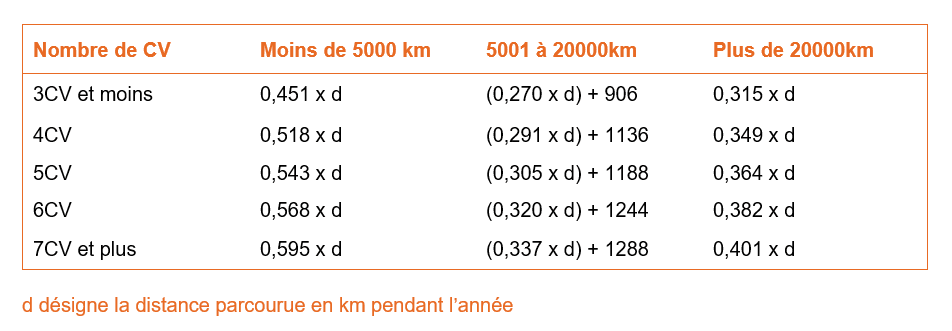
Mileage scale 2020
The mileage expense scale for 2020 for calculating the mileage deduction applicable to the 2020 income tax return has not yet been published. Here is the IK scale for 2019.
Reimbursement of mileage expenses excluding cars
Reimbursement of mileage expenses by bicycle
Since 2016, the tax administration allows reimbursement of mileage expenses, through a mileage allowance, for bicycle trips.
The rules for calculating mileage expenses:
- Reimbursement is made based on 25 cents per kilometer traveled.
- Each employee is not entitled to a reimbursement amount exceeding €200 per year.
Please note that the use of an electric bicycle is also entitled to mileage reimbursement, under the same conditions.
The payment of the mileage allowance related to the use of their personal bicycle by the employee is not mandatory for the employer.
Mileage reimbursement for scooters
Despite the growth of this mode of transport, the Government has not yet established regulations on the reimbursement and calculation of mileage costs for scooters. It is likely that, given the evolution of customs, the application of the mileage allowance to scooters should evolve — with the payment of an allowance per kilometer traveled.
Mileage reimbursement for carpooling
Employees who use carpooling cannot accumulate mileage allowances: only the vehicle owner can request reimbursement of their mileage expenses.
Read also: Managing expense reports — the most common mistakes
Mileage allowance and mileage: Solving the puzzle
Managing mileage expenses can be time-consuming and often involves significant administrative effort. All of this has a cost that can be reduced by optimizing mileage expense management. How? By using a comprehensive application designed to meet the expectations of every professional, regardless of the size of the organization. N2F has been designed for this purpose.
An all-in-one application to manage your mileage quotas
Among the advantages of the N2F application is the Google Maps module, integrated into both the mobile application and the web application, which saves valuable time. It offers the possibility to quickly find the distance traveled, ideal if you forgot to check your odometer. No need to leave the application to obtain the information you need to reimburse your mileage allowance. You enter the starting and ending locations, and N2F automatically calculates the distance traveled, including any stops along the route, as well as the amount of mileage expenses to be reimbursed. The application is always up to date with the applicable mileage expense scale and applies it automatically based on the fiscal power of your vehicle. The undeniable benefit: a travel proof is generated immediately and associated with your trip.
This module is associated with one called Places. The goal is still to save time; this module allows you to enter the name of the company without having to search for its address yourself. The distance will be automatically calculated.
Another key feature of this application dedicated to mileage expenses is the ability to save favorite trips. If you have recurring clients, it is not uncommon for you to visit them regularly, so you don’t have to waste time entering that route again. Once saved, you just pick it up and add it to your monthly trips. For a restaurateur who sources supplies every day or every week from the same place, this feature is a must.
But we chose to go even further by considering all possibilities. Thus, N2F is able to deduct the distance to work if one of your employees leaves home and not the company to go to a client, thanks to the “departure from my home” function.
In N2F, you can easily set up your vehicle: fiscal power, energy… You can even photograph all regulatory documents, such as a registration certificate and an insurance certificate.
Opt for a simpler and more intuitive management of your mileage expenses and forget about complicated calculations. N2F is a reliable solution that ensures you are up to date with current regulations, protecting you against any tax adjustments. Indeed, the mileage scale is modified in real-time as soon as it is published. However, if you have the option to apply your own scale, we allow you to customize our application. Try our 2F application for free.

Tag: understanding mileage reimbursements