Hitachi air conditioners and heat pumps display fault codes in the form of alphanumeric combinations on the remote control, the indoor unit, or the outdoor unit. Reading these codes is not technically difficult. However, correctly interpreting them requires understanding what each family of codes measures and which component it relates to.
Hitachi Fault Codes and Self-Correcting Diagnostics on Multi-Split Models
Hitachi multi-split installations present a recurring issue: a code displayed on one indoor unit may indicate a fault located on another unit or on the outdoor unit. The E7 code (fan) illustrates this phenomenon well.
Since the adoption of self-correcting diagnostics in 2025, technicians have reported a trend of decreasing unnecessary interventions for this E7 code, with a significant reduction in false positives on multi-unit installations, according to feedback published on the Frigoristes.fr forum in April 2026. Specifically, the system automatically restarts a verification cycle before freezing the fault code, which filters out transient alerts related to micro-cuts or voltage variations.
To consult in detail the list of Hitachi air conditioning fault codes along with the causes associated with each alert, one must cross-reference the unit number, alarm code, and model code. These three pieces of information alternate in the temperature setting area of the remote control or on the display of the outdoor unit’s electronic board.

Table of Hitachi Air Conditioning Error Code Families
Hitachi fault codes are grouped by family according to the type of malfunction detected. The table below presents the most common categories in residential and semi-industrial ranges.
| Code Family | Concerned Component | Frequent Origin | Priority Action |
|---|---|---|---|
| Transmission Codes (e.g., alternating blinking) | Indoor unit / outdoor unit connection | Remote control cable break, poor contact, faulty CCH or microcomputer | Check wiring continuity, tighten connectors |
| Safety Device Activation Codes | Indoor unit (circuit breaker, fan motor) | Fan motor failure, condensate drainage issue | Check the water drainage tray, test the motor |
| Outdoor Unit Codes (protection, PC) | Compressor, inverter board | Safety device activation, overcurrent, gas fault | Check gas pressure, condition of the compressor |
| Thermistor Codes | Temperature sensors (incoming air, heat exchanger) | Abnormal thermistor operation, disconnected sensor | Measure sensor resistance, replace if out of tolerance |
| Inverter / System Transmission Codes | Frequency converter, connection between boards | Control transmission failure, voltage anomaly | Inspect the inverter board, check power supply |
This classification by family allows for directing the diagnosis towards the correct component without testing each component randomly. A transmission code is not treated like a thermistor code: the former points to wiring, the latter to a sensor.
Particularity of Yutaki and airHome Ranges
On Yutaki heat pumps, fault codes also include alerts related to the hydraulic circuit (water pressure, flow). A code that resembles a refrigeration fault may actually indicate a problem with the circulation pump or a clogged water filter.
The airHome systems add a layer of filtering via the connected application, which translates the raw code into a simplified message. This translation is useful for initial sorting, but the simplified message sometimes obscures the actual cause of the fault.
Hitachi Predictive AI 2026 and Over-Diagnosis Risks
The Hitachi models announced for 2026 incorporate predictive AI algorithms capable of triggering an alert code even before a failure manifests. The principle is based on the continuous analysis of performance deviations: if the compressor’s consumption deviates from the reference curve, the system generates a preventive code.
For a professional, this anticipation reduces dry failures and facilitates planning interventions. For a non-professional user, the situation becomes complicated. A preventive code displayed on the remote control or in the application resembles a classic fault code. Nothing in the standard display clearly distinguishes a predictive alert from a confirmed fault.
- A predictive code related to the gradual clogging of filters may appear while the device is functioning normally, prompting the user to call a technician for a simple cleaning operation.
- A code anticipating a refrigerant gas pressure drift may trigger an expensive intervention while the leak is not yet measurable, making on-site diagnosis inconclusive.
- The accumulation of preventive codes on a multi-split installation may give the impression of a failing system, while each alert taken in isolation does not justify a shutdown.
The risk of over-diagnosis mainly affects residential installations where the end user does not have the tools to distinguish an informative alert from a blocking fault. Professionals have access to detailed histories via the Hitachi maintenance software, which classifies alerts by level of criticality.
Checks Before Calling a Hitachi Air Conditioning Technician
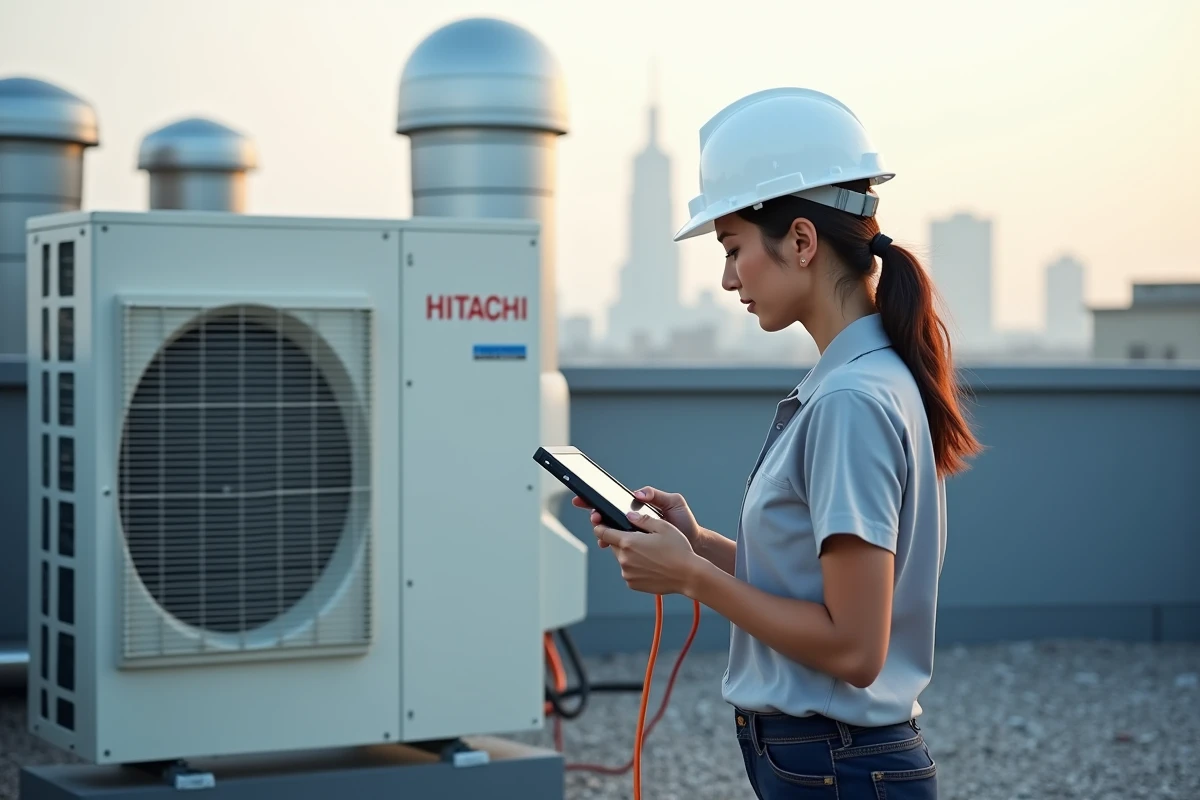
Before requesting an intervention, several points can help eliminate simple causes that generate fault codes without a real failure.
- Clean the filters of the indoor unit: a clogging is enough to trigger codes related to airflow or the incoming air thermistor.
- Check that the condensate drainage tray is not blocked: a water level that is too high activates the safety device and blocks the unit.
- Cut off the power supply for a few minutes and then restart: some transmission codes disappear after a reset, especially in the case of a micro-network cut.
- On heat pumps, check the water circuit pressure on the group’s manometer: too low pressure generates an error code unrelated to the refrigeration circuit.
A code that reappears after a reset indicates a persistent fault that requires the intervention of a qualified technician. A code that does not return likely corresponded to a transient disturbance.
The distinction between persistent code and transient code remains the most reliable criterion for deciding whether a technical intervention is necessary. With the arrival of predictive alerts on recent models, this distinction becomes even more crucial to avoid unjustified repair costs.