
In the delivery room, the midwife announces two distinct weights, sometimes separated by several hundred grams. Parents mentally compare this with the benchmarks they have been given for a single child, and nothing adds up. Twins follow their own growth trajectory, with thresholds and warning signals different from those of a singleton.
Growth curves specific to twins: why the benchmarks change
The classic curves used in maternity wards have long been based on singleton pregnancies. A twin assessed on these curves often appears “small,” which generates disproportionate concern. The curves from the Intergrowth-21st project, increasingly used in neonatology, show that twins diverge from singletons starting in the third trimester. This divergence is physiological, not pathological.
In practical terms, it is observed that the ideal weight for newborn twins is below that of a singleton born at the same term, without indicating a growth delay. The challenge for the medical team is to position each baby on the correct curve, the one that corresponds to a twin pregnancy, to avoid unnecessary interventions or, conversely, insufficient monitoring.
When professionals use these adapted references, the interpretation of birth weight changes dramatically. A twin born around the twin average with steady growth does not require the same level of alert as a twin positioned below the tenth percentile threshold of these specific curves.
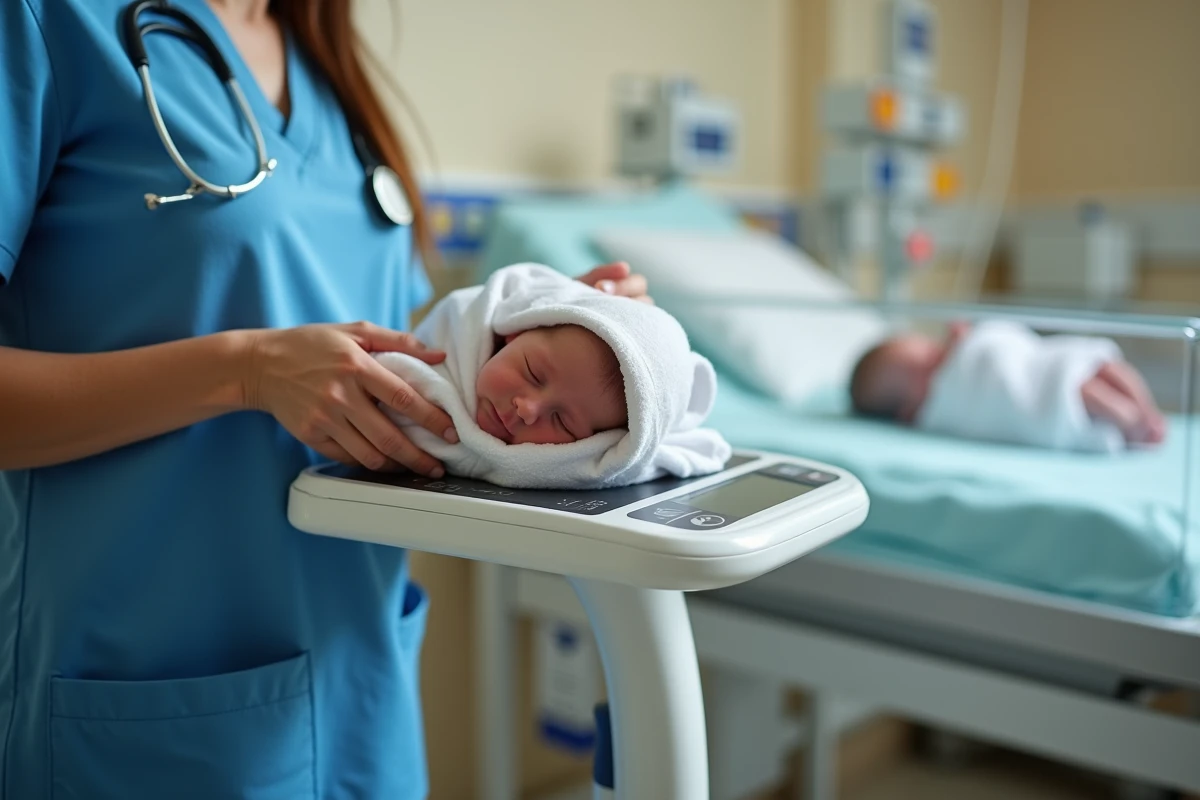
Weight discordance between twins: when to be concerned
The weight difference between the two babies is one of the most monitored parameters. It is calculated as a percentage of the weight of the larger twin. A moderate discordance, between fifteen and twenty percent, is common and does not in itself constitute a warning signal.
Data from recent European cohorts show that, for twins born between the thirty-fourth and thirty-seventh week without other comorbidities, this moderate discordance is associated with a good medium-term neurodevelopmental prognosis. The condition: that weight gain is harmonious in the first three months of corrected age.
This point nuances the dramatization often observed in maternity. A weight gap at birth does not predict future development on its own. It is the catch-up dynamic that matters.
When discordance becomes severe
Beyond a twenty percent difference, monitoring becomes tighter. According to data from the CHU of Besançon, most severe discordances are detected antenatally, allowing for proactive management. Associated risk factors include:
- A pregnancy-related vascular pathology (hypertension, pre-eclampsia) affecting about one-third of pregnancies with severe discordance
- An earlier delivery, with a significant proportion of births before the thirty-fourth week in this subgroup
- A higher induction rate related to vascular complications
Severe discordance is therefore not an isolated figure: it fits into an overall clinical picture that the obstetric team monitors from the first trimester, particularly through the measurement of cranio-caudal length and nuchal translucency.
Feeding low-weight twins in maternity: current protocols
When a twin is born with low weight, the question of feeding arises immediately. Practices have evolved in recent years. Several recent hospital protocols encourage breastfeeding even for twins around two kilograms, where previously there was a more systematic orientation towards specific formulas for preterm infants.
The strategy relies on several levers used simultaneously:
- Early establishment of pumping, ideally within the first hours, to stimulate lactation even if the babies are not yet effectively breastfeeding
- Co-feeding combining breast with a tube or lactation aid device, so that the baby receives a sufficient volume while learning to suck
- Fortification of breast milk in neonatology, which allows for increased caloric and protein intake without abandoning breastfeeding
This approach improves weight catch-up curves. For parents, it also has the advantage of maintaining a direct bond with the babies during a period often marked by anxiety and separation due to the stay in neonatology.

Mixed or exclusive breastfeeding: adapting without guilt
Feedback varies on this point, and each situation is different. Some mothers achieve exclusive breastfeeding for their two twins, others switch to mixed feeding after a few weeks, while others choose formula from the outset. The key criterion is the weight curve of the babies, not the method used.
The neonatology team adjusts the protocol based on each child’s digestive tolerance and milk production. One twin can be breastfed while the other receives a supplement, without it posing a medical issue.
Post-maternity follow-up: the corrected life of the first weeks
Once at home, the weight monitoring of twins is done in corrected age. A baby born at thirty-five weeks will be evaluated as a newborn of zero weeks five weeks later. This correction generally applies until two years for motor and cognitive development.
Regular weigh-ins (at PMI, with the pediatrician, or with a midwife at home) allow for tracking the curve of each twin individually. Comparing twins to each other is natural but medically irrelevant: each has its own catch-up rhythm.
What alerts a professional is not a low absolute weight, but a break in the curve, meaning a sudden slowdown in weight gain over several consecutive weigh-ins. A light twin who is regularly gaining weight on their twin curve is a baby who is doing well.
The most reliable benchmark for parents remains consistency. An upward and steady curve is better than an isolated reassuring number. The first weeks are intense, but the vast majority of twins born around the average twin term catch up to standard curves in the first months of corrected life.