
Choosing a healthcare facility on the French Riviera involves more than checking a ranking. The factor that matters most in everyday life is how quickly you can access care from where you live and whether you can maintain regular follow-up without interruptions.
The region has a dense concentration of services along the coast, between Menton and Mandelieu, but the picture changes as soon as you move inland. The Provence-Alpes-Côte d’Azur Regional Health Agency (ARS PACA) has also identified five priority areas in the fight against medical deserts. Before comparing reputations, ask a more practical question: which facility near you can ensure continuity of the care you need?
Access to care and continuity on the French Riviera: the real selection criteria
Do you live in the mid-altitude or upper hinterland of the Alpes-Maritimes? The journey to Nice or Antibes can take more than an hour, and sometimes longer in winter. For regular care (rehabilitation, dialysis, specialist appointments), travel time matters just as much as the facility’s technical capabilities.
Being nearby is not enough if the service you need is not available on an ongoing basis. A facility may have a fully equipped technical platform during the week but offer only certain specialties at weekends or overnight. ARS PACA clearly distinguishes between on-site out-of-hours care, organized at night, on weekends and public holidays for certain types of care, and general access to emergency care.
Before making a decision, ask the facility directly: what care is actually provided on site, and at what times? A regional directory such as https://www.rivierasante.fr lets you compare facilities and their services across the French Riviera, so you don’t have to make multiple exploratory calls.

Qualiscope and HAS certification: how to read the right indicators
You may already have heard of healthcare facility certification. The French National Authority for Health (HAS) publishes these results through a public tool called Qualiscope. In practical terms, it provides access to certification decisions and indicators covering patient experience, patient safety and care coordination.
This information is useful for choosing between two facilities in the same area. But it does not replace direct verification.
Multi-site certification: a common pitfall
HAS explains that multi-site facilities may be assessed as a group and share the same certification decision. Each site is assessed according to the medical services it actually provides. A good overall score does not guarantee that your specialty is available at the nearest site.
What to do: consult the certification report and check that the specific site and service you need are included in the scope of the assessment. A facility certified A in Nice does not necessarily offer the same level of service at its branch in the hinterland.
What Qualiscope doesn’t tell you
The tool does not provide information on appointment waiting times or additional fees charged. On the French Riviera, most specialists work in Sector 2, where they can charge above the standard rate. For those who remain in Sector 1, waits can stretch to several months for certain specialties, such as ophthalmology or rheumatology.
Emergency care, overnight cover and medical triage in Provence-Alpes-Côte d’Azur
You might assume that the nearest facility is automatically the right place to go for an unplanned medical need. In reality, out-of-hours primary care in the PACA region relies on prior medical triage. This may direct you to an on-call doctor, an out-of-hours medical centre or the emergency department if the situation requires it.
This distinction affects how you choose a facility for ongoing care. If your condition could lead to an emergency (cardiology, poorly controlled diabetes, post-operative follow-up), check two things:
- Does the facility provide overnight and weekend cover in your specialty, or only general emergency services?
- If a complication arises outside normal hours, does the care pathway involve telephone triage or direct access?
- Is there a transfer protocol to a specialist centre if the facility cannot manage the situation on site?
Confusing emergency department services with hospital cover for a specific specialty is a common mistake that can significantly delay care.
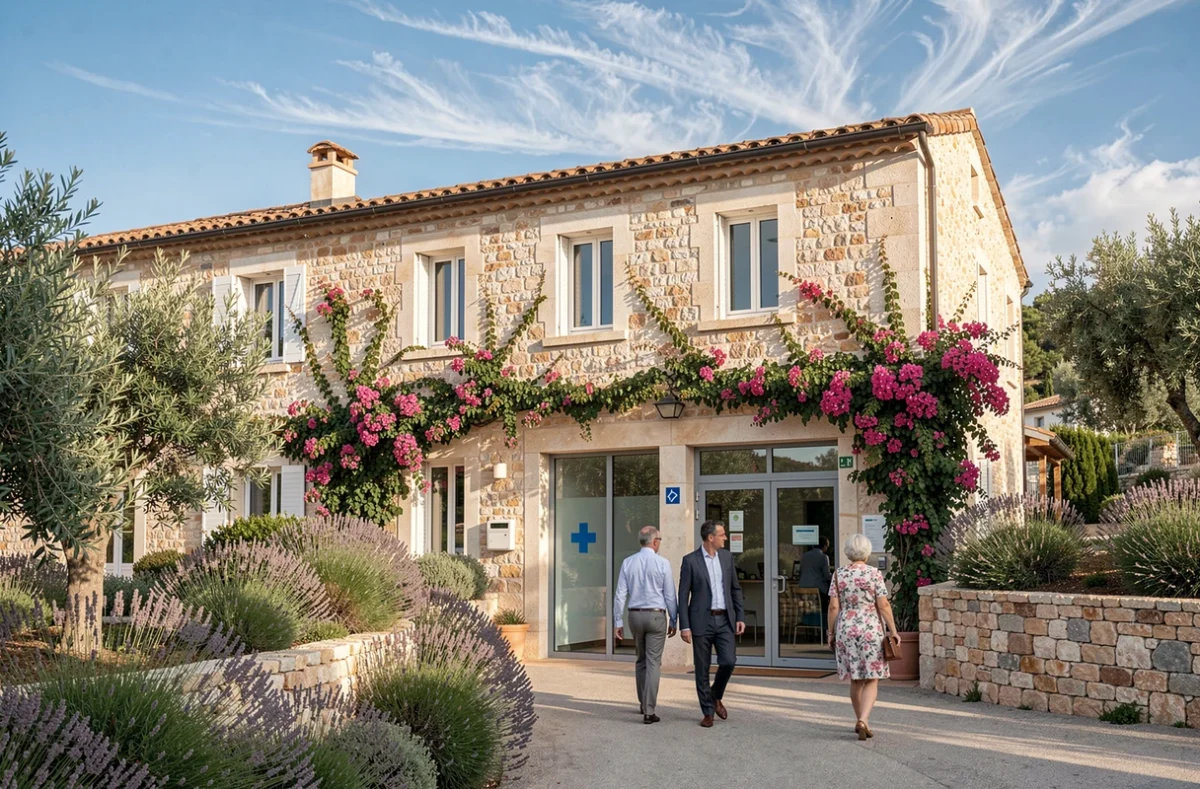
Practical criteria for comparing healthcare facilities on the French Riviera
Rather than using a theoretical checklist, here are the factors that make a difference when choosing a facility, especially when several seem equivalent on paper.
- Number of procedures in your specialty: a facility that regularly performs a procedure generally achieves better results than one that performs it only occasionally. This figure is sometimes available in HAS certification reports.
- Practitioners’ fee sector: on the French Riviera, additional fees for the same specialty vary considerably from one facility to another. Requesting a written estimate before any planned procedure is the most reliable way to know what to expect.
- Coordination with community-based care: does the facility send a report to your GP within 48 hours? Does it offer shared follow-up through a digital record? This coordination is essential for continuity of care after discharge.
- Accessibility from your home: calculate the actual travel time, not just the distance. Winding roads in the Nice hinterland can add considerably to the journey.
Nursing homes and social care facilities: additional criteria
For a residential care home for older people who need support with daily living, quality-of-life indicators matter just as much as medical indicators. The ratio of care staff to residents, the activities on offer and the approach to maintaining independence are all factors to assess during an in-person visit.
No online ranking can replace a visit. Take in the atmosphere, talk to the staff and, if possible, speak with residents’ families.
Choosing the right healthcare facility on the French Riviera has less to do with reputation than with how well the facility’s actual services match your needs, whether they are available when you need them, and whether it is close enough for regular follow-up. Checking its certification, calling to ask the right questions and calculating the journey are simple steps that can prevent gaps in care—gaps that even the best reputation cannot make up for.