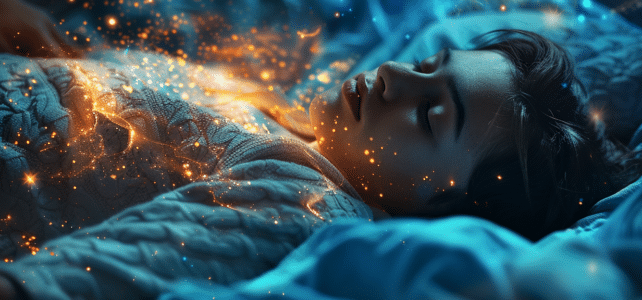
The understanding of dreams weaves an intriguing web between the human psyche and the mysteries of the supernatural. When a dream embraces elements that go beyond ordinary understanding, it fascinates and questions. These nocturnal visions, often linked to forces that seem to transcend our reality, spark particular interest among those seeking to decipher the hidden messages behind the dream images. Dreams of this nature invite a deep exploration of personal beliefs and cultural archetypes, thus revealing unsuspected layers of our subconscious. How then should we approach and interpret these nocturnal scenarios tinged with the supernatural?
The Foundations of Analyzing Supernatural Dreams
Supernatural dreams, these sequences of images and emotions occurring during sleep, fascinate with their revealing potential. Sigmund Freud, the father of psychoanalysis, delved into their interpretation, highlighting the role of the unconscious in their formation. The work ‘The Interpretation of Dreams’, published in 1900, marks a turning point in the understanding of these nocturnal phenomena. Freud develops the idea that dreams are the royal road to knowledge of the unconscious, where latent thoughts take shape and manifest.
In sacred texts such as the Bible, dreams hold significant importance. They are seen as privileged channels through which God communicates with mankind. Joseph, an emblematic figure from the Old Testament, is notably known for his prophetic dreams, influencing the course of biblical history. These narratives illustrate a conception of dream of spirit as a herald of signs and wonders, and even as a vector for announcing future events.
The latent content of the dream, according to Freudian theory, holds the true meanings, hidden beneath the manifest content. Supernatural dreams can be interpreted as the symbolic representation of aspirations, repressed desires, or internal conflicts. Freud encourages deciphering these symbols to access buried thoughts. Consider the recurring elements and associated emotions to decode the message your unconscious is trying to communicate.
However, the understanding of dreams does not stop at the individual. Carl Gustav Jung, Freud’s student and later dissident, expanded the field of analysis by introducing the notion of collective unconscious. For Jung, dreams can also reflect universal archetypes shared by all humanity. Supernatural symbols, such as God or the Holy Spirit, could thus be interpreted as manifestations of these archetypes, referring to shared experiences beyond the personal sphere.

Practical Approaches to Interpreting a Dream Related to the Supernatural
Analyzing dreams related to the supernatural, often tinged with mysticism and esotericism, requires a methodical approach. Consider the individuality of the dreamer: each person carries within them a unique mental universe, shaped by their life, experiences, and culture. The interpretation of a dream cannot therefore be done without an intimate understanding of the personal context in which it occurs.
To approach the dream related to the supernatural, discern the manifest content from the latent content, according to the Freudian distinction. The former represents the images and events as they are experienced in the dream, while the latter contains their true meaning, often veiled. The task of the analyst or the informed dreamer is to interpret these symbols to extract a coherent meaning aligned with the dreamer’s psychological state.
In this quest for meaning, the notion of memories plays a fundamental role. Dreams can be populated with distorted memories or echoes of reality, mixed with fantastical elements. By carefully transcribing the dream upon waking, the dreamer captures these fleeting fragments of memory to later submit them to analysis.
For those venturing into the interpretation of supernatural dreams, open-mindedness is essential. Do not dismiss nocturnal visions as mere inconsequential chimera. Jung and Freud teach us that, sometimes, dreams are bridges between our consciousness and the collective unconscious, or even warnings or messages to be deciphered. The supernatural in dreams can then be perceived as a symbolic language to decode, offering keys to better understand our inner world and, perhaps, the world around us.